
When I was asked to give a ‘master-class’ on professional audio, I wondered, first of all, what sort of information I might have that would be both interesting and useful for University students and graduates, and that would be outside the regular curriculum.

The answer comes fairly easily, and it’s the result of the differences between my professional education and yours:

I would assume (that awful and dangerous word!) that most of you decided on ‘sound engineering’ or some related subject as a vocational choice, being interested and involved with some aspect; maybe music playing or writing as a very young person, reading about aspects of sound in magazines, and being drawn to what is obviously a creative and worthwhile career choice.

You will have already learned heaps about related subjects; acoustics, music theory, basic electronics, microphones, loudspeakers, digital recording and the use of software in the audio visual domain.
So you know quite a lot about it….. I’m quite sure that you are already all well up on that famous curve where ‘the more you know, the more you realise there is to know.’

40s CHILDHOOD

When I was a very small child, my father used to let me watch him as he would build electronic and radio projects using tinsnips, coils of wire and solder. I got an enduring interest in both electronics and music at that time, and it continued throughout my childhood; it was the normal thing for all children in the 1940s to take piano lessons; I learned both piano and violin, and later took up reeds and guitar.

TAPE RECORDER

When I was at grammar school in Tunbridge Wells, my father and I did a joint project, actually making a working tape recorder out of odd bits; and that was not a kit!

At school I studied maths and physics and somehow, I thought it would be a good idea to become a civil engineer, because there was obviously no money in electronics!

I got a job as an engineering learner with a local authority and played music in the evenings, so I started out as a civil engineer with a band (!) My day job was helping design and build roads and bridges, in the evenings I would play in bands, and because I had an interest generally in things electrical, I ended up organising the PA with very little money, and then, with mostly home made equipment I like to think that I spotted the career opportunity… I started making primitive recordings, with absolutely no experience or guidance, I was strictly an amateur.

As a band we worked hard, and were good enough singers to get noticed, and by a series of good fortunes and a lot of effort, we, that is my brother, my wife and myself, managed to get regular work as session singers and occasional musicians in the London studios. We worked regularly for Joe Meek at his Holloway Road studio; which was no more than 3 rooms above a leather shop, and we learned a lot! (ad lib)

CAREER CHANGE

I quickly decided in 1963 that civil engineering and the pop music business did not mix. I quit my job and managed to talk my way into starting a little demo recording facility in Denmark Street for Keith Prowse Music.
With the practical recording expertise that I had gained watching the action in other studios, my own little place became successful and I was able to build up the equipment, some bought and some home-made, until the results were ‘professional’ and useable in the business generally, that is; as library music, quality demos, TV and film music and even some singles. (EXTEND ON ‘LIBRARY’)

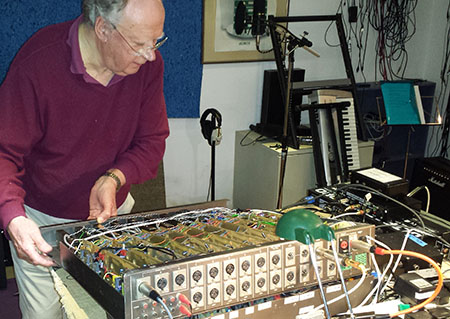
In 1968, I was asked to build my first audio console, and the industrial side started from there.

So you see, my background is really a series of coincidences and moves within which I had to learn a whole heap of basics that many of my peers were convinced that I knew already! For example; I distinctly remember at one of the earliest sessions with Joe Meek, him talking about ‘foldback’ and I was totally bemused, having no idea what it was.

DENMARK STREET.

It’s worth talking about recording techniques of that time, for a few minutes…..
Once I had the studio kitted out as I wanted it, we had two stereo tape machines, these were TEAC, Japanese copies of the famous Ampex 350 machines, A home-made 10 channel mixer with valve channels, fitted with an invention of mine to give stereo positioning; later to be known as ‘pan pots’, some massive Lockwood-Tannoy loudspeakers and a few ‘toys’ in a rack. There was a spring reverb unit, an Altec compressor, some early prototype photoelectric compressors and odd bits and pieces of headphone amplifiers, meters and bits of jackfield bought from surplus stores in Lisle Street.
I did have 2 channels of homemade EQ; the circuits were very simple passive networks.

These were really exciting times:
They were the days when the Rupert Neve company was supreme, when Dick Swettenham and Clive Green were just starting Helios and Cadac.

There were a handful of enthusiastic young engineers in Denmark Street at the time. In spite of being with rival companies, we all had very limited budgets, but we were all trying very hard to produce good sounds, and so we would lend and borrow equipment all the time; I used to lend microphones and compressors to Southern Music, across the road when they had an important session, and John Mackswith, the engineer there, used to do the same for me.

(RECORD The Ivy League Tr 5)
That one was recorded at Southern Sound, a tiny basement studio underneath Southern music on the other side of Denmark street from me.
The compression on it is a giveaway…. I honestly can’t remember for sure, but I think it was one of my photoelectrics on the voices.

One of the key things we learned quite early was that there’s no substitute for a good microphone: Put up a good mic in a reasonably ‘dead’ environment, and you’re halfway there.

I had a Neumann KM56 and some Shure type moving coils, but my prized microphone was a Telefunken large diaphragm original, with no label on it; It was an M251, but the very early ones did not have the ‘Neumann’ type diamond logo, or maybe it had been removed. I remember that I had to make a power supply for it.

(GENERAL DISCUSSION ABOUT MIC PLACING ETC??)

On the previous track that I played, I mentioned the compression on the voices…. This one is an American production recorded at almost exactly the same time. The approach to controlling voice levels is quite different; the engineer has used a Universal Audio 1176, which gives the whole thing a tightly controlled sound.
(RECORD…. Mr Tambourine man Tr 7)
But we shall come back to compressors later.

EQUALISERS

What I really wanted to talk about first this evening is equalisers.

Now I’m sure that you have been thoroughly grounded in what an equaliser is supposed to do and how to use it, but I will start from what’s possibly a different place.

The ‘equaliser’ was originally designed by engineers in the motion picture industry for a very simple and vital purpose; it was to ‘equalise’ the sound of recorded voices. Microphones have different responses at different distances, and acoustic environments made speech recordings sound different, even in the same scene, so it was vital to have some electronics that would make them all equal… hence ‘equalise’…. It’s not very common knowledge nowadays that in the UK film industry, they were keen NOT to follow the lead of Hollywood, but the problem was just the same. They called it ‘compensation’, which became shortened to ‘comp.’ But more recently that term has fallen into total disuse because it’s too similar to the ‘comp’ of ‘compressor’.

Early equalisers used simple passive circuits to get HF lift and cut, a degree of mid frequency lift, and some control of LF.

BRIEFLY, the equaliser got developed using valves and then transistors and integrated circuits. Up to the late 1950s all equalisers used passive circuits which removed frequency bands and then made up the gain with a simple linear amplifier: If you remove MF and LF, and then amplify what’s left, you get HF lift, it’s as simple as that. The ultimate example of this type was the ‘Pultec’.


Until digitally modelled equalisers were common, there were only a small number of equaliser types, there was the that original passive type, the state-variable filter type made possible by using a number of operational amplifiers arranged as filters with feedback. This is technically a superbly flexible design type, but unfortunately it’s possible to get a whole range of effects that are nothing like natural! And then there’s the highly successful Baxandall family of designs.


BAXANDALL
In 1958 (ish) a clever engineer at EMI developed a circuit that could give boost and cut at HF and LF using selective feedback. His name was Peter Baxandall. His circuit rapidly became the industry standard for all sorts of equalisers and ‘tone controls’. The circuit was simple and effective, and actually sounded good.

In 1993, I wrote a piece about equalisation in ‘Studio Sound’ magazine. In it I mentioned the name of Peter Baxandall as the originator of all decent modern equalisers. I was surprised a few days after publication when I got a phone-call from the man himself. He told me that since he developed and published the circuit in the 50s, almost no one had recognised him, and he had not earned a penny from it.
I would have loved to have met Peter but unfortunately he was ill at the time. He died in 1994.

GOOD SOUND.

If we admit that we need equalisers as tools in the recording business; (there are some, even more extreme than me who say we don’t,) then it’s important that they should sound good, and by that I mean that the effect that they produce should be pleasing to the ear and not distracting or unmusical.

Now the Baxandall equaliser is basically HF lift and cut, and LF lift and cut.
It is a shelving equaliser; it works by shifting the relative phase of different frequencies. One of the questions that I dearly wanted to ask Peter Baxandall was: “Did you intend the circuit to mimic nature?” Because that’s exactly what it does!
Going back to films and dialogue for a moment, distant speech reaches your ears after being modified considerably by reflections from the environment. These reflections affect higher frequencies more than lower, the result is generally a deadening of the high frequencies due to complex cancellations taking place. This adds up to what is effectively HF cut, and a phase lag.
By using a ‘Baxandall’ equaliser and adding a touch of HF lift, you can correct (or equalise) this effect making the voice sound closer, yet still natural, because the equaliser mimics and corrects for the effect exactly.

Technically, the Baxandall equaliser can only correct at a maximum rate of 6dB per octave, and this is only achieved at high values of lift or cut. Consequently, the phase shifts are gentle, and because of that, the sound is natural and sweet.
The converse is with so called ‘parametric’ equalisers ( which are usually ‘state-variable’ models) where different and more extreme ‘Q’ values can be selected. Here, the changes in amplitude with frequency can be severe; consequently the sound of the modified audio is harsh and unnatural.

TESTS

A couple of years ago I looked into the performance of some digital equalisers in respect of phase performance. Interestingly, but not unexpectedly, the regular ‘plug-in’ designs supplied with the less expensive digital systems, like ‘Sound Forge’ and ‘Cubase’, did not fare too well. Although they shifted phase in the right directions, they did not match what I considered to be the perfect or natural shape. The best digital equaliser I tried at the time was actually the regular channel EQ in the Yamaha 02R, it was very good in the HF and LF if used gently, however the mid frequencies left a lot to be desired.

So to be practical and specific about phase change and ‘Q’ values, if you feel that you have to use an EQ, then bear in mind that to retain any naturalness at all, the ‘Q’ value should be not more than 1, representing changes in amplitude of 6dB per octave. (‘Q’ in this context is actually the fundamental frequency divided by the range of frequency covered by the 3dB down points.)

BANDWIDTH

While we are on the subject of what sounds good in the way of equalisation, have you ever wondered about the relationship between audio bandwidth and what sounds natural?
There is an odd effect that was a part of the knowledge learned by early film recordists; it concerns restricting the bandwidth of audio signals.
Early soundtrack recordings were severely restricted as far as frequency response goes, it was difficult to record anything outside the range of say 200Hz and 5KHz. The main restriction was the difficulty of recording the high frequencies, so when the recordings were played back, they sounded dull and muddy.
Some bright spark worked on some dialogue tracks with one of those early equalisers, and found that if the LF end of the spectrum was cut by a similar amount to the HF end, then the track started to sound remarkably natural again. For example, take an octave off the top, match it with an octave off the bottom and the thing starts to sound as though it was never filtered in the first place.
I have a thought about the reason for that; I think that it’s to do with the way the ear compensates all the time for our environment. It is such a powerfully adaptable and adapting instrument, although here It’s more than the ear itself, it’s the whole hearing mechanism, of which more than half is in the interpretation that’s put on the stream of impulses that go from the ear to the brain.

This ‘top and bottom’ effect is much less important nowadays, when we have no problem at all recording the full range of frequencies, but it has got relevance if you are trying to fit dialogue into a music sequence say, and the voice is too distracting. It could easily be an opportunity to do a bit of bandwidth restriction to smooth the effect.

At the risk of sounding really boring, I have to repeat what you must have heard many times before; don’t use an equaliser unless you have a clear idea of what you are doing or trying to achieve.

Using an equaliser is distorting the audio signal, it’s changing its spectrum, altering the relative loudnesses. Gentle use of equalisation will pull sounds forward or push them away. Any more violent use will cause confusion to the ear and destroy the illusion that the brain has created. It’s almost like looking at one of those three-dimensional computer pictures that you have to train your eyes to see; once you can see the hidden image it is as clear as anything, but if anything disturbs you, the image collapses and your eyes see chaos.

Of course there’s a place for more extreme equalisation, it’s in effects where you will be trying to get a particular guitar sound or make the piano sound even more striking, and yet isn’t it strange how often you think you can achieve an effect with ‘just a bit more EQ’ yet when it comes to it, it really doesn’t work, all you achieve is brown mush or grating distractions.

No, the best engineers are very sparing with the EQ, they use very small amounts of ‘tilt’ to achieve positioning and detail, but they rely heavily in microphones, microphone placing and good performance to get good recordings.

(INVITE QUESTIONS…. GENERAL DISCUSSION ABOUT USE OF EQ)

(RECORD The Ragpicker’s Dream Disk2 Track 10)
(GENERAL PRODUCTION TOPICS….)


COMPRESSION

During the mixing process, the three factors which most affect the placing of the sound in a mix are RELATIVE LEVELS, RELATIVE FREQUENCIES, and COMPRESSION.

The RELATIVE LEVELS are taken care of, obviously, in the mixing process, with faders.
The RELATIVE FREQUENCIES can be adjusted to some extent with EQ.
So we come to the most neglected factor, COMPRESSION.

Now, we are not talking about ‘compression’ as a method of reducing dynamic range here. That’s a function of compression where the aim is to make the effect as transparent as possible; it’s just to fit the signal into the available dynamic range on the medium you’re working with. Very briefly, this is best achieved nowadays by some very clever computer algorithms that operate independently on different frequency bands, yet are timed cleverly so that they are not noticeable (except for their dreadful misuse on Radio 2, where the voices of the presenters make me cringe).
What we are talking about is three areas of compression;

1) Compression of individual signals; instruments or voices.
2) Group compression.
3) Overall compression.

I’m going to be just a little controversial here; most recording engineers try to record the human voice completely ‘flat’ (with no effects) so that any required effects can be added later during the mixing process. When I record a solo voice, I usually use a little compression. The reason is that to make a voice audible in a mix, some compression is always necessary, but the real reason is probably that until very recently it was not possible to record the true dynamic range of a voice at all!

The purpose of individual signal compression is to stabilise their position in the mix.
If you have read any of my writings about compression, I generally go on about the automatic biological compression effects of the ear, how our ears ‘turn down’ loud sounds. My compressor designs try to imitate the time constants of the ear because when we apply this sort of compression to a signal, whether it be instrument or voice, we are fooled into thinking that it’s louder than it really is.
In practice this works really well, and my own tests demonstrate (to me at least!) that numbers of signals, individually compressed can be mixed without causing confusion.

Of course, individual signal compression is almost always necessary for an artistic reason as well; it’s needed to control the dynamic range of the loud parts and to make the quiet parts useable. That may sound obvious, but it’s still essential for all but the most ‘purist’ recordings.

JOE MEEK AGAIN.

When Joe Meek recorded lead vocals, his method was to drive the output of his microphone amplifier directly into a compressor, and from there, into his mixer, and then on to tape. This worked well and I have always done the same, in fact, that’s the basis for the various ‘Voice Channels’ that I have designed over the years.

TDC.

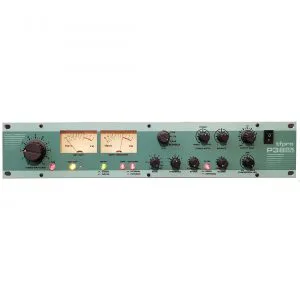
To digress for a moment, the latest ‘Voice Channel’ that’s still in development will again be a combination of mic amp, compression and harmonic enhancer. It will be a transformer linked mic preamp followed by an asymmetric compressor, that takes into account the way the human voice is very non-symmetrical, and then a harmonic enhancer and a peak limiter.

(ASYMMETRIC COMPRESSION AD LIB)

OTHER SIGNALS.

I have to suggest that it’s generally not such a good idea to use compression on individual musical instruments, except possibly guitars in a pop music context.
Some compression is often necessary (for dynamics reasons!) when recording brass sections, but it’s easy to get quite horrid results using compression on strings or most reed instruments. You can hear some early mistakes in this respect on records of the 1970s where the producer tried to use the Mellotron as an instrument, the results were uniformly horrible, and I think mainly because of the necessary heavy compression used to ‘smooth out’ the dynamics of the instruments; as well as the poor sample recordings of the time.

GROUP COMPRESSION.

The most obvious and most effective use of compression is where you group together a number of sound sources into a sub-group, and apply compression to the whole group at one go.
The drum sub-group is the one that springs to mind straight away, and this is where creative musical compression comes into its own.

It’s always a good thing to have a drum kit sounding louder than it actually is! I’m tempted to say that it’s difficult to overcompress most sorts of drums on pop records; I’ve seen them compressed to the most amazing extremes, and definitely the best sort of compressor for this is the slow photoelectric like the old Joemeek SC2 or its modern equivalent.
A fairly slow attack time and a shortish release would sound too ‘breathy’ on most things, but on drums it can give depth and urgency, and hold them stable so that they become the backbone of the mix.
In my compressor designs I always tailor the sidechain response so that the compression is less sensitive to low frequencies. What this means is that you can compress the whole kit with some extreme compression without worrying about the bass drum causing ‘wallowing’ , in fact you can even include the bass guitar within the same sub-group, making the ‘bass and drums’ really tight.
You could write in the same characteristics to a software compressor, but I can absolutely guarantee that it won’t sound the same!

Group compression is also very useful with vocal group recording. Here again one can use some quite severe compression, but the release time is more critical because of how we hear the human voice; any sort of ‘flutter’ as the compression acts, can sound very unnatural. The classics for a demonstration of the use of EFFECT compression on voices are the Beach Boys, and even more so, Queen.
(RECORD…..

MASTERING COMPRESSION.

We mustn’t get confused here between compression for the sake of getting the dynamics of a recording onto a medium which requires a lower dynamic range, and compression for effect.

That first sort of mastering compression is best taken care of by highly specialised multi-band compressors; usually digital, that control dynamics with as little audible effect as possible. No, my field is in compression for effect, and when the producer wants to add urgency and excitement to a recording, then this is the best way to do it.
When the end product was a 7 inch 45 rpm vinyl record, producers had an easy choice; it was to drive the final mix through a valve compressor with a slowish attack time and about 350mS release time so that it would sit at about 15dB of compression (or even more). That way, the sound would leap out of the record…. But it would sound just a little squashed!
(CD DEMO RECORD OF OVER COMP.)

I think we are a little more sophisticated now and we can learn lessons from the old records , making the sounds still jump out when we want them to, but being able to control the enthusiasm.

(Settings)

(DISCUSSION… QUESTIONS)

(CLOSE)

Copyright Ted Fletcher 2005